
Chickpea is India’s most grown and most consumed pulse — accounting for 40% of total pulse production. Available in two types: desi (small, dark, India’s dominant type) and kabuli (large, cream-coloured, export-oriented). It is a cool-season legume that fixes nitrogen, improving soil fertility for the next crop. Widely known as ‘poor man’s meat’ for its high protein content.
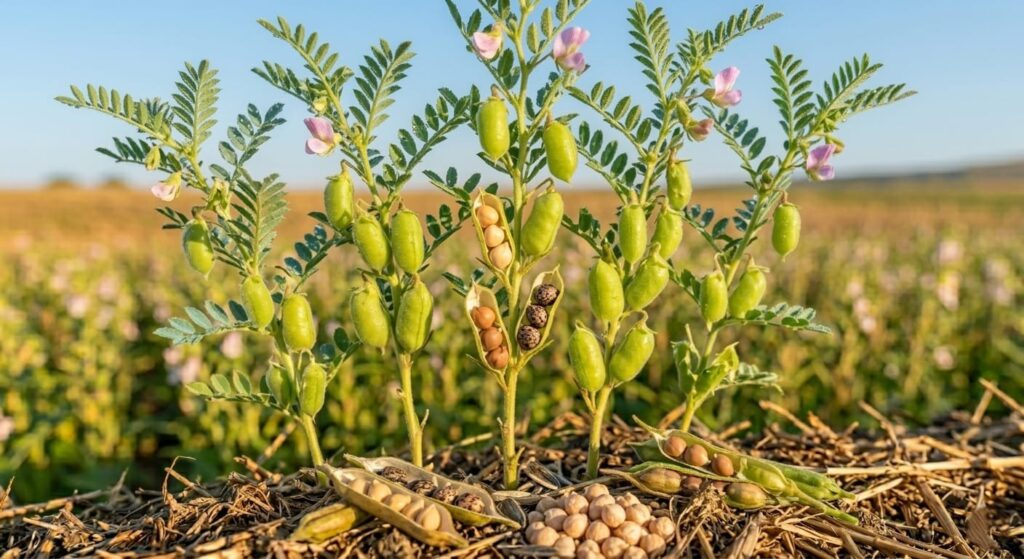
Chickpea (Chana / Gram)
Cicer arietinum
Pulse Overview
Common Pests
Pod Borer (Helicoverpa armigera)
Symptoms:
Round holes in pods with caterpillar excreta (frass) visible; larvae feeding on developing seeds inside pods.
Cutworm (Agrotis ipsilon)
Symptoms:
Seedlings cut at soil level at night; gaps in field stand; caterpillars found coiled in soil during day.
Common Diseases
Fusarium Wilt (Fusarium oxysporum f.sp. ciceri)
Symptoms:
Wilting at seedling or adult stage; yellowing lower leaves; brown discolouration inside stem at soil level.
Treatment:
Remove infected plants; apply trichoderma bio-control to soil; practice 4-year rotation.
Ascochyta Blight (Ascochyta rabiei)
Symptoms:
Dark brown lesions with concentric zones on leaves, stems, and pods; stem girdling causes lodging.
Treatment:
Apply organic copper-based fungicide spray at early infection; remove crop debris.
Soil Requirements
Chickpea is best suited to light, well-drained sandy loam or loamy soils. Waterlogging and heavy clays are detrimental. It performs well on residual soil moisture after a kharif crop — making it an excellent fit in a soybean or rice-based cropping system.